21 August 2012

The missing 14th C sleeveless shift

I'm afraid work and hot weather mean no actual interesting things of my own to report on.

However, in more Lengberg-related news, Cathy Raymond has written an interesting blog post about late medieval underwear, specifically the Lengberg pants and whether they are a male or female garment.

She also links to a recent PDF by Rebecca Lucas, who has hunted through the literature to answer one of the great mysteries of late medieval underwear. Namely, the source of the sleeveless "chemise of the fourteenth century" shown in a black-and-white photograph in Kohler's "A History of Costume":


It is from a cash of objects found during building work in 1867 in Burg Rahnis, Thuringia, Germany. It is described as being made of coarse linen, not silk as has been previously speculated, with "inserted wedges on both sides" (translation by Rebecca Lucas). It was kept in a private collection, possibly the museum at Burg Rahnis - however, this museum was sacked in World War II and its contents stolen. The whereabouts of the shift is currently unknown.

However, that's a lot more information than I previously had - simply that it was lost in World War II.

14 August 2012

Germanic weirdness

Someone Germanic, please, please make a reproduction of this!

Oh, my goodness. How much weird awesomeness can you fit into one effigy? It's got utterly bizarre tippets, an off-the-shoulder dress for Elizabeth, and look at those slits with the three buttonholes on Ulrich's tunic. Interestingly, they both have long, loose, wavy hair and a band around the head - possibly this is because they were both children when they died, as is revealed in the inscription (see bottom of page).

4 August 2012

Fingerloop: primary sources

There are three main primary sources for 15th C European fingerloop braids: 'The Tollemache Book of Secrets', 'Harley MS 2320' and 'Natura Exenterata: Or Nature Unbowelled' (sometimes referred to as 'Serene', the surname of the attributed author of the braiding section). There are also 17th C European fingerloop braids which are quite different from the 15th C ones, but I will not be investigating those.

Cindy Myer has a list of publications for these manuscripts. Most notably, there is a free facsimile and transcription of the braiding section of Serene. Also, there is a free facsimile of the entire Harley MS 2320.

Serene is, perhaps, the most intriguing of the manuscripts. Despite being published in the mid-17th C but its braids are very similar (or the same) as those in the 15th C manuscripts, and unlike those in the other 17th C manuscripts. Its discovery was reported in L-M BRIC News, where you can read more about it and its braids.

1 August 2012

Fingerloop: a few braids

Here are a few of my recent attempts at fingerloop, all in cotton (as it's cheap and I have lots):


From left to right:

  1. A brode lace of v bowes
    • I attempted to learn more about the structure of this braid and how the moves produce the braid by using as many different coloured bowes as possible, so that I could see which move created which pattern. As I only had 4 colours of thread at the time, there are 2 brown bowes.
  2. A brode lace of v bowes
    • More of the same, to attempt to understand how the pattern is made. This braid uses 3 blue bowes and 2 brown bowes. The right hand acted as instructed, but the left hand picked up bowes unreversed instead of reversed. The result? The tension in the braid is uneven, resulting in the entire braid spiraling somewhat annoyingly.
  3. A brode lace of v bowes
    • Yet more of the same. This braid uses 3 light blue bowes and 2 brown bowes. I did a section as instructed, then did an overhand knot to mark the change, then did the remainder with both hands picking up bowes unreversed. The result? Picking up unreversed makes the same braid but upsidedown - what was the upper, visible face when braiding now is the lower, invisible face.
  4. A lace common round
    • Using 3 green bowes and 2 dark blue bowes.
  5. A lace maskel (Harley 2320 version)
    • Using 4 pale blue and 4 pink bowes. This lace spirals somewhat and the holes are not visible unless it is purposely stretched out. The lace compacts a lot when held under tension vertically, rendering the pattern less visible.
  6. A lace maskell (conjectural Serene version)
    • Cindy Myers suggests the lace maskel instructions in the Tollemache and Harley manuscripts are incorrect and suggests a conjectural version based on the Serene MS instructions and the name ('maskell' apparently means 'a voided lozenge')
    • This produces a nice lace-like braid, though it too has a tendency to spiral and requires purposeful stretching to look its best. The lace-like pattern collapses when held under tension vertically.
    • My braid has a fair few mistakes (that may or may not be visible in the photo). I kept forgetting where I was and how many repeats of the horizontal exchanges I had done. However, the principle of the pattern is there.
  7. Lace cowe de race
    • I kept trying but could not make this look like Cindy Myers' example. The problem is with the instruction "A goes through B right from within outward, under all the loops of both hands, and takes the over side of A left reversed". I am unsure quite what is meant by the underlined section.
    • I tried several contortions to attempt to "take the over side of A left reversed" but neither were satisfactory: one resulted in the 'vertical' threads changing colour (see between the second and third set of 'stitches'), the other resulted in the 'stitch' threads pushing up through the 'vertical' threads (see below the fourth set of 'stitches')
    • It is clear that, however this move works, the same colour should remain on the top half of the bow - if this doesn't happen, the 'vertical' threads will change colour

So, those are all of my experimental braids so far. I did do some others at a show I was at last week, but those are just more 'brode lace of v bowes' and 'lace common round of v bowes' that were to keep myself from boredom and to have something to talk about.

I also taught a friend's daughter the 'brode lace of v bowes'. She was quite content to only learn that pattern, but was amazing at creating colour combinations (including several I'd never even considered) - she kept fishing in my thread bag and drawing out amazing combinations, with colours I didn't even know I had. Unfortunately, I am no where near as talented at the colour selection as she is!

30 July 2012

Lengberg underwear: thoughts on the pants

Just pondering on the Lengberg underwear some more...

I am curious as to why some people (often re-enactors, or SCA) are so adamant that the bikini-like pants must be a female garment. The argument of "women must have worn pants" doesn't make much sense to me. We know that in many later eras women did not routinely wear pants (or wore crotchless ones), making that argument (at least in its most blanket form) false.
I can certainly understand the argument that "women must have done something at that time of the month" - but why does it have to be pants (a la mens'), and why does wearing something for one's period automatically equate to wearing something for the rest of the month too? This argument seems particularly nonsensical to me when it comes to the mid-1300s and before, when mens' braies were huge baggy things that would not be able to hold any conjectural medieval sanitary pad close against the crotch.

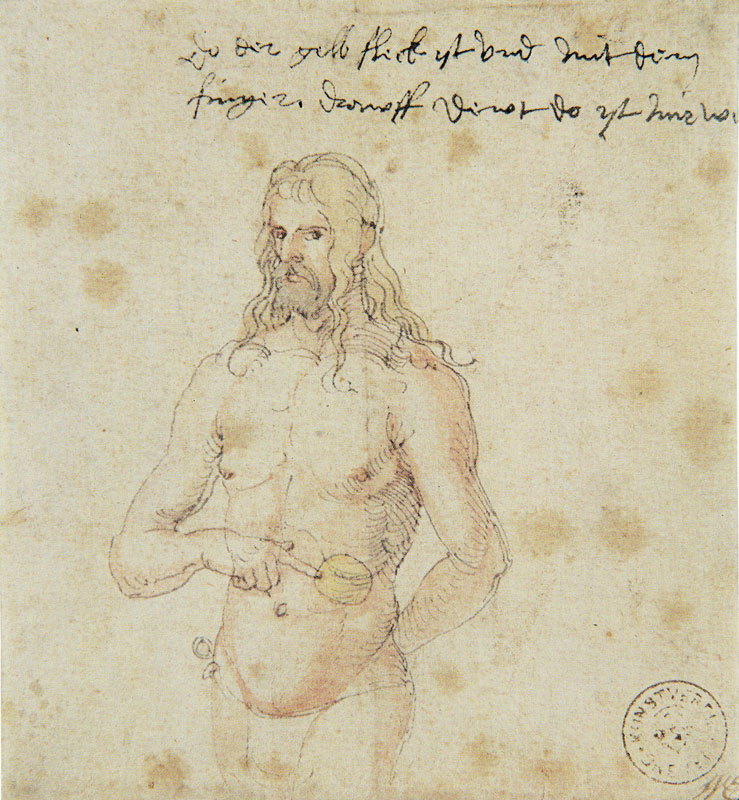
In any case, the argument I've been reading about the Lengberg pants in particular is that they look nothing like the mens' braies seen in 14th C and 15th C manuscript illustrations. True. However, a lot of those illustrations are French or English. Also, may I direct you to a woodcut and a sketch by Albrecht Durer: The Men's Bathhouse (c. 1498) and Self Portrait as an Act (c. 1507). Yes, these are at the very end of the 15th C / very beginning of the 16th C. However, I don't know how precise the Lengberg radiocarbon date of "15th C" is. Also, the images are from the correct country. In any case, they definitively show men wearing bikini-style pants.

28 July 2012

Lengburg underwear: more articles

Seeing as I know there are a few of us out there who are waiting with baited breath for any fresh details regarding the Lengberg underwear finds, I thought I would share these two articles from medievalists.net. The latter article is particularly interesting as it describes the four 'bras'/'corslettes', including the placement of the sprang which had been mentioned previously. Apparently it is between the cups on at least one of the 'bras'.

And, of course, now that I go look there appears to be several new articles that have popped up over the last few months, which I have not noticed before:

19 July 2012

Oddities: Full-face Veiling

Every once in a while I come across something that stands out as being rather different. Something rather odd.

Here is one of those things: in a detail from a Durer altar painting (All Saints' Picture, Landauer Altar, 1511) is a lady. She sits at the extreme right of the painting and wears an otherwise pretty typical example of late 15th C / early 16th C German clothing. However, her veil completely covers her face, revealing only her eyes.

That's the only example of full-face veiling I've seen in a Western European historical context. Please do enlighten me if you know of any other examples!