Showing posts with label extant clothes. Show all posts

31 May 2020

Herjolfsnes errors: Norlund 88 (Museum No. D10613)

Following discussion on the Herjolfsnes Challenge, it was agreed that it would be useful to have a repository of the errors, inconsistencies and unclear statements in Woven Into the Earth and Medieval Garments Reconstructed, the two reference books about garments from Herjolfsnes, Greenland. These have been collated by members of the Herjolfsnes Challenge.

This blog post deals with errors that directly relate to Norlund 88 (aka D10613). As more errors are found, they will be added to this repository. If you have noticed any, please let us know and we will add them.

All page numbers refer to the English-language versions of either Woven Into the Earth (WitE-E) or Medieval Garments Reconstructed (MGR-E). When the Danish-language versions are referred to, they will be denoted as WitE-D (i.e. Som syet til jorden) and MGR-D (i.e. Nordbomønstre).

For the full repository of Herjolfsnes errors, see this page.


Page 163 MGR - errors in scale drawing of original pattern.
Found by Miriam Griffiths.

The description of this garments says: "The stocking foot consists of six pieces, the two longest of which continue from midway below the foot around the heel up into the leg. Three pieces start from one and the same point under the sole. The fourth is a 'heel'." (WitE-E, p. 223-224). It also refers to the scale-drawing in this book on p. 297. This drawing clearly shows the six foot pieces. Two (the "two longest" from the description) consist of what would have been the two sides of the lower section of the leg piece, wrapping around the heel. Three (the "three pieces start from one") consist of a pieced foot-piece; one is cut on-grain rather than bias. The last is a slim oval-shape associated with the heel-area, which prevents the usual late medieval hose issue of having a seam running dead-centre on the underside of the foot. It did not extend into the foot-piece.

In contrast, the corresponding diagram on p. 136 of MGR-E is different. The three pieced bits that make up the foot-piece are shown as three separate pieces here, as in the WitE-E diagram. However, all three are shown as bias-cut. Additionally, the oval "heel" is depicted as being part of one side of the lower foot piece. In doing this, the cut of this piece has also been changed - in WitE-E it is bias-cut but in MGR-E it is almost on-grain.

23 April 2020

Herjolfsnes errors: Norlund 33 (Museum No. D5674)

Following discussion on the Herjolfsnes Challenge, it was agreed that it would be useful to have a repository of the errors, inconsistencies and unclear statements in Woven Into the Earth and Medieval Garments Reconstructed, the two reference books about garments from Herjolfsnes, Greenland. These have been collated by members of the Herjolfsnes Challenge.

This blog post deals with errors that directly relate to Norlund 33 (aka D5674). As more errors are found, they will be added to this repository. If you have noticed any, please let us know and we will add them.

All page numbers refer to the English-language versions of either Woven Into the Earth (WitE-E) or Medieval Garments Reconstructed (MGR-E). When the Danish-language versions are referred to, they will be denoted as WitE-D (i.e. Som syet til jorden) and MGR-D (i.e. Nordbomønstre).

For the full repository of Herjolfsnes errors, see this page.

28 November 2018

Herjolfsnes errors: Norlund 63 (Museum No. D10594)

Following discussion on the Herjolfsnes Challenge, it was agreed that it would be useful to have a repository of the errors, inconsistencies and unclear statements in Woven Into the Earth and Medieval Garments Reconstructed, the two reference books about garments from Herjolfsnes, Greenland. These have been collated by members of the Herjolfsnes Challenge.

This blog post deals with errors that directly relate to Norlund 63 (aka D10594). As more errors are found, they will be added to this repository. If you have noticed any, please let us know and we will add them.

All page numbers refer to the English-language versions of either Woven Into the Earth (WitE-E) or Medieval Garments Reconstructed (MGR-E). When the Danish-language versions are referred to, they will be denoted as WitE-D (i.e. Som syet til jorden) and MGR-D (i.e. Nordbomønstre).

For the full repository of Herjolfsnes errors, see this page.

Herjolfsnes Errors: Introductory chapters

Following discussion on the Herjolfsnes Challenge, it was agreed that it would be useful to have a repository of the errors, inconsistencies and unclear statements in Woven Into the Earth and Medieval Garments Reconstructed, the two reference books about garments from Herjolfsnes, Greenland. These have been collated by members of the Herjolfsnes Challenge.

This blog post deals with errors in the introductory chapters - i.e. all of Woven Into the Earth except the catalogue of finds and Chapters 1-3 of Medieval Garments Reconstructed. As more errors are found, they will be added to this repository. If you have noticed any, please let us know and we will add them.

All page numbers refer to the English-language versions of either Woven Into the Earth (WitE-E) or Medieval Garments Reconstructed (MGR-E). When the Danish-language versions are referred to, they will be denoted as WitE-D (i.e. Som syet til jorden) and MGR-D (i.e. Nordbomønstre).

For the full repository of Herjolfsnes errors, see this page.

6 July 2013

Pink lower class dress: finding a pattern

I wrote before about my new project, a pink wool dress for scumming about camp in when it's cold and/or wet (as it so often is when reenacting in Wales...). Having found my inspiration, the next thing to do was to find a cutting pattern.

21 August 2012

The missing 14th C sleeveless shift

I'm afraid work and hot weather mean no actual interesting things of my own to report on.

However, in more Lengberg-related news, Cathy Raymond has written an interesting blog post about late medieval underwear, specifically the Lengberg pants and whether they are a male or female garment.

She also links to a recent PDF by Rebecca Lucas, who has hunted through the literature to answer one of the great mysteries of late medieval underwear. Namely, the source of the sleeveless "chemise of the fourteenth century" shown in a black-and-white photograph in Kohler's "A History of Costume":


It is from a cash of objects found during building work in 1867 in Burg Rahnis, Thuringia, Germany. It is described as being made of coarse linen, not silk as has been previously speculated, with "inserted wedges on both sides" (translation by Rebecca Lucas). It was kept in a private collection, possibly the museum at Burg Rahnis - however, this museum was sacked in World War II and its contents stolen. The whereabouts of the shift is currently unknown.

However, that's a lot more information than I previously had - simply that it was lost in World War II.

30 July 2012

Lengberg underwear: thoughts on the pants

Just pondering on the Lengberg underwear some more...

I am curious as to why some people (often re-enactors, or SCA) are so adamant that the bikini-like pants must be a female garment. The argument of "women must have worn pants" doesn't make much sense to me. We know that in many later eras women did not routinely wear pants (or wore crotchless ones), making that argument (at least in its most blanket form) false.
I can certainly understand the argument that "women must have done something at that time of the month" - but why does it have to be pants (a la mens'), and why does wearing something for one's period automatically equate to wearing something for the rest of the month too? This argument seems particularly nonsensical to me when it comes to the mid-1300s and before, when mens' braies were huge baggy things that would not be able to hold any conjectural medieval sanitary pad close against the crotch.

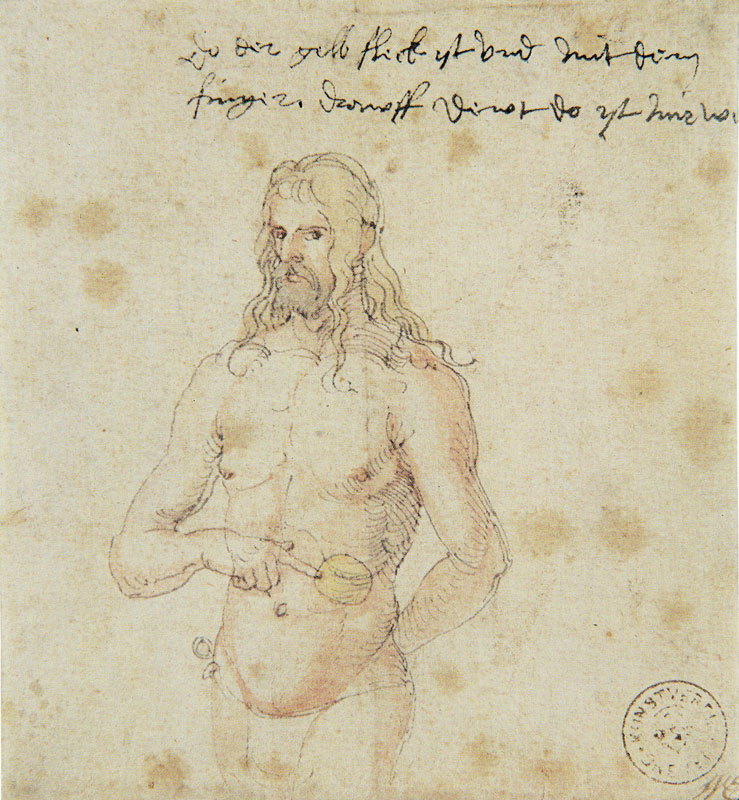
In any case, the argument I've been reading about the Lengberg pants in particular is that they look nothing like the mens' braies seen in 14th C and 15th C manuscript illustrations. True. However, a lot of those illustrations are French or English. Also, may I direct you to a woodcut and a sketch by Albrecht Durer: The Men's Bathhouse (c. 1498) and Self Portrait as an Act (c. 1507). Yes, these are at the very end of the 15th C / very beginning of the 16th C. However, I don't know how precise the Lengberg radiocarbon date of "15th C" is. Also, the images are from the correct country. In any case, they definitively show men wearing bikini-style pants.

28 July 2012

Lengburg underwear: more articles

Seeing as I know there are a few of us out there who are waiting with baited breath for any fresh details regarding the Lengberg underwear finds, I thought I would share these two articles from medievalists.net. The latter article is particularly interesting as it describes the four 'bras'/'corslettes', including the placement of the sprang which had been mentioned previously. Apparently it is between the cups on at least one of the 'bras'.

And, of course, now that I go look there appears to be several new articles that have popped up over the last few months, which I have not noticed before: